

Privacy management is understanding the internet’s ability to spread and exploit personal information and applying this knowledge to an individual’s own internet experience and behavior. According to the website, this is defined as “The ability to handle with discretion all personal information shared online to protect one’s and others’ privacy.”
Being proficient at privacy management means understanding an individual’s right to privacy and keeping your own private information secured. Knowing that you do have a digital footprint and taking steps to manage this to contribute to a positive online presence. This includes working on what information an individual chooses to share on the internet and what safety precautions are taken. Further, privacy management is recognizing and respecting others right to privacy.
The threat of oversharing on the internet ranges from the person’s own reputation to businesses acquiring as much personal information as possible for their own corporate benefit. To provide an example, information that is made public online can be sold to third party buyers that utilize it for tailored advertising campaigns, products, and services. An internet user’s behavior, posts, and online preferences are continuously tracked by companies who want to use this relevant information. Without privacy management, internet users online information can be exploited.
Privacy itself is a fundamental human right as determined by the UN Declaration of Human Rights. According to privacyinternational.org, “Privacy enables us to create barriers and manage boundaries to protect ourselves from unwarranted interference in our lives, which allows us to negotiate who we are and how we want to interact with the world around us. Privacy helps us establish boundaries to limit who has access to our bodies, places, and things, as well as our communications and our information.” This all applies within the internet as well, however, the privacy laws in place are not up to date with the 21st century and internet. The laws get muddied as the lines between what information is considered private or what is not is challenged. This is why privacy management is so valuable. It is up to the individual user to mandate their own internet privacy and exercise privacy management to safely exist on the internet
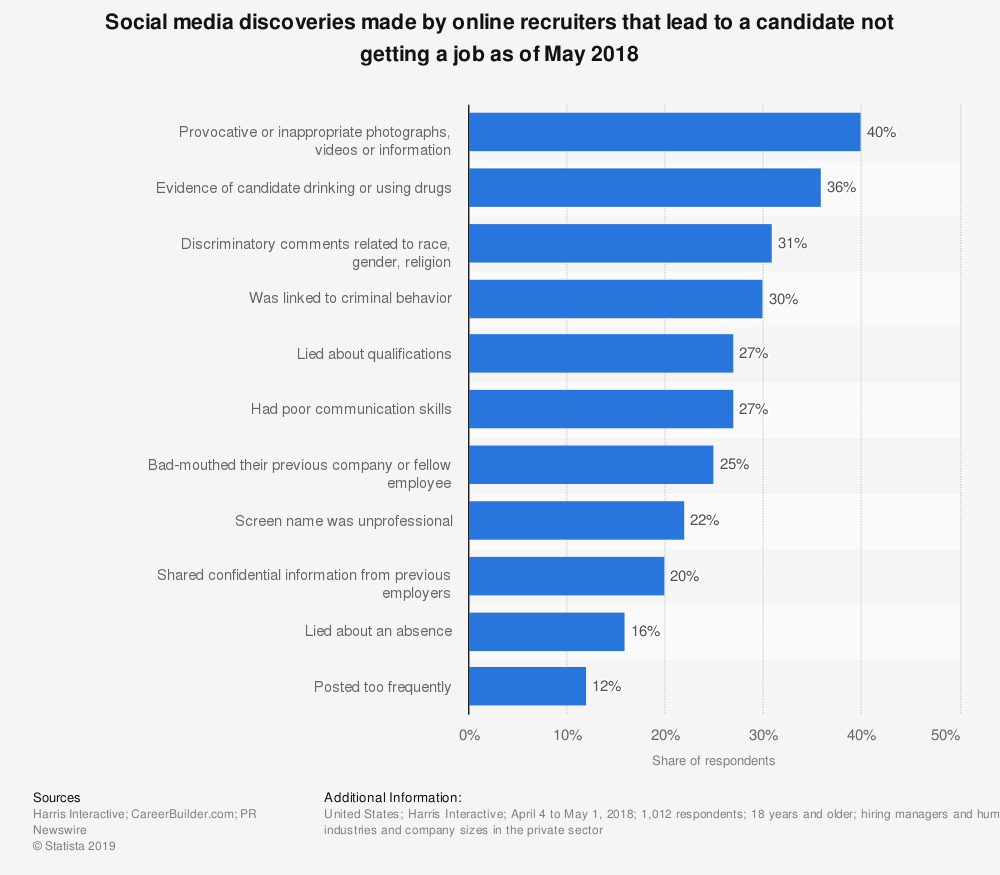
As shown in the graph above, ones internet presence is often a factor in job recruitment. Recognizing this fact and acting accordingly is a part of effectively exercising privacy management. Because jobs and companies have access to personal information that was posted online, internet users should post keeping this in mind and being consious of their internet presence.
The threat of oversharing on the internet ranges from the person’s own reputation to businesses acquiring as much personal information as possible for their own corporate benefit. To provide an example, information that is made public online can be sold to third party buyers that utilize it for tailored advertising campaigns, products, and services. An internet user’s behavior, posts, and online preferences are continuously tracked by companies who want to use this relevant information. Without privacy management, internet users online information can be exploited.
Privacy itself is a fundamental human right as determined by the UN Declaration of Human Rights. According to privacyinternational.org, “Privacy enables us to create barriers and manage boundaries to protect ourselves from unwarranted interference in our lives, which allows us to negotiate who we are and how we want to interact with the world around us. Privacy helps us establish boundaries to limit who has access to our bodies, places, and things, as well as our communications and our information.” (What is Privacy?) This all applies within the internet as well, however, the privacy laws in place are not up to date with the 21st century and internet. The laws get muddied as the lines between what information is considered private or what is not is challenged. This is why privacy management is so valuable. It is up to the individual user to mandate their own internet privacy and exercise privacy management to safely exist on the internet.
This is important to a Wai’anae Moku student because, as a college student who uses the internet, you are vulnerable to people access to your information and interpreting you online presence. There is a lot people can do with your information from the internet, it is better to stay safe and protected.
What Is Privacy? (2017, October 23). Retrieved from https://privacyinternational.org/explainer/56/what-privacy
Valentino-DeVries, Jennifer; Singer, Natasha; Keller, Michael H.; Krolik, Aaron (2018-12-10). “Your Apps Know Where You Were Last Night, and They’re Not Keeping It Secret”. The New York Times. ISSN 0362-4331.
Dinev, T., and Hart, P. Internet privacy concerns and their antecedents– Measurement validity and a regression model. Behavior and Information Technology, 23, 6 (2004), 413-423. [Google Scholar]
 Deana Goslin's Blog